Posts

Showing posts with the label Chiropractor

What’s in a Name? Musings on Ship’s Names and History

Image
16th Century England's Most  Infamous Privateer Ahead of the curve on the handlebar moustache trend. I f you do any research into 16 th maritime history, there’s no denying that Sir Francis Drake was an incredible mariner, explorer, tactician, and businessman. It should also be noted, however, that he got his start as a slave trader, thanks to his earlier association with his cousin Christopher Hawkins. Starting as the son of a tenant farmer, he was able to make his way to the royal court of Queen Elizabeth I. By the age of 40 he had travelled all over the known world and amassed great wealth and fame; he was also the second person to circumnavigate the globe and claimed California for England. As a privateer, he was a national hero as he filled England’s coffers with plundered Spanish gold and silver; to the Spanish, he was known as a dreaded pirate with a bounty on his head. Capturing the Nuestra de Whatever In 1577, Queen Elizabeth asked Drake to attack Spanish s...

The Jerky Buccaneer: A Brief History of Pirates and Smoked Meat

Image
The origin of the word "buccaneer" leads you down the barbecue trail! A " Buccaneer " was a type of privateer or pirate who typically roamed the Caribbean Sea during the 17th and 18th centuries.  The origin of the name comes from a corruption of the name used by the French to describe the hunters of wild boars and cattle in the largely uninhabited areas of Tortuga and Hispaniola. The me at from the animals they caught was slowly smoked over a low fire on a wooden framework or hurdle the native people called a “buccan” or “boucan.” The French called them boucanes which were used to make viande boucanée – what we would call jerked meat or jerky. The Spanish called the same process "barbacoa," which later became known as "barbecue." The illustration to the right is a depiction of a "Buccaneer of the Caribbean" by famous pirate artist Howard Pyle.  The most popular meat for smoking on the boucan was pork, but any meat wo...

A Health to the Company: A Brief Overview of 18th Century Shipboard Medicine

Image
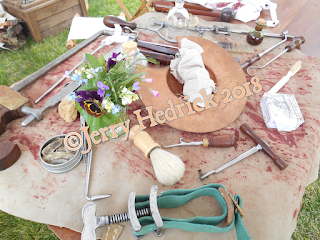
Enemy Fire Wasn't A Sailor's Greatest Threat to Health Demonstrations of 18th century medicine are fairly common at reenactments and historical sites. It’s both interesting and frightening for people as they imagine themselves in the place of an injured or sick person 300 years ago. I enjoy this particular bit of living history because, although primitive to us today, they really were practicing the height of technology of their time—and some of it obviously worked, because here we are today--at least some of our more hearty ancestors survived it, though it might have “cost them an arm and a leg.” My shipboard medical and surgical kit, ready for action. Oh, and a nosegay, so it smells nice. Early 18th  century shipboard medicine and the treatment of injuries and disease sounds just as perilous to us, if not more so, than the general medicine of the times. Doctors and surgeons were mostly self-taught, with the idea of standardized medical schools still a...